
Case studies | June 20, 2026
How Focaldata replaced spec-driven development with prototypes
Focaldata, one of London’s 30 fastest growing companies, provide market research for some of the biggest names in the world. Organisations like The Gates Foundation, Airbnb, Anthropic and Starbucks rely on their services to conduct research at speed.
In 2025 Focaldata embarked on building out their new AI product, FDAI, an agentic platform built for researchers to complete self-serve research products from launch to results.
Competition in multiple billion dollar markets
Focaldata were in the unique position of attacking two multi-billion dollar markets: research and AI.
For anyone trying to compete in one large market, let alone two, the speed of production development has to be high. At the start of 2025, FDAI’s roadmap was filled with core functionality that was going to create the bulk of the AI agent product, but there was, as there always is, room for more iterations and especially user feedback to be addressed.
One of the things that slowed down the team the most during development was the handoff between product and engineering, which typically leaned on specification documents or PRDs that were dense and detailed out a lot of the user experience in plain text.
And whilst this process has been around for years, thanks to the transformation with large language models, we were able to start embarking on a different type of product and engineering relationship.
We began to move away from long Jira or linear tickets that would describe our functionality and instead towards something that was far more detailed and would be easier for an engineer to understand. It would come with the added benefit of being in code already, unlike a Jira ticket or a Figma design.
Starting with prototypes
To begin with, Sakky set the precedent by becoming the first non-engineer to ship code to production. He was one of the earliest users of Claude Code, first using it to launch an entire prototype of the FDAI platform in June 2025. With that experience, he then took it forward and introduced the functionality to a few key members of the team:
- Justin (CEO)
- Mason (Head of Growth)
- Duncan (AI qual lead)
- Jasper (Growth Executive)
These were team members who had massive amounts of context and understanding for the FDAI product, but previously would have to communicate across their ideas through specification-driven development.
Overnight, the team were totally transformed. Equipped with access to the codebase in a safe and protected environment (away from production code) they began to start creating prototypes for new functionality that lay months ahead in the roadmap.
Since that training session, the team has almost eliminated spec-driven development using traditional ticketing methods.
Upgrading to the codebase
Once the team were comfortable creating typically throwaway prototypes they began to start the journey to moving to real production code with all its nuances and quirks.
The team was given system prompts and a new tool called Conductor to allow them to orchestrate agents and automations. These were created that allowed them to get specific feedback from engineers who knew it was a vibe coded experience that needed to be turned into production-grade code.
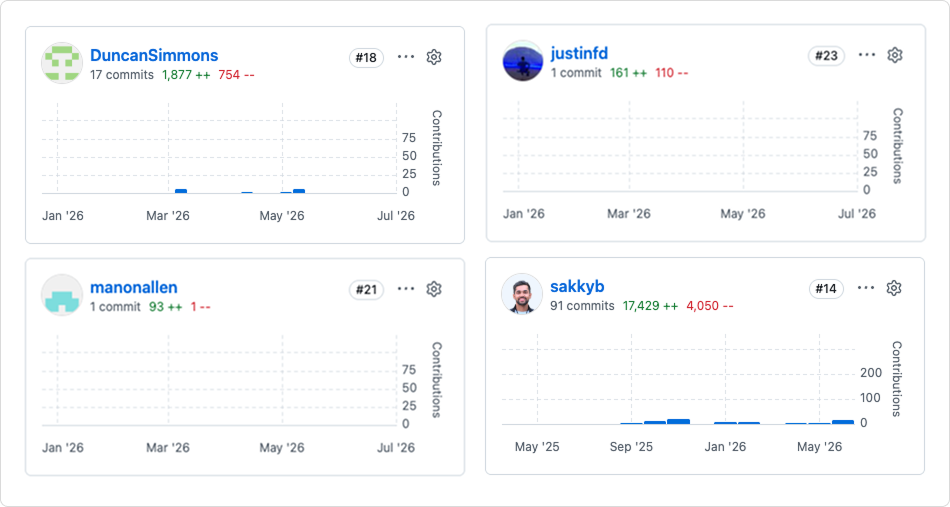
This chart shows the contributions to the real FDAI codebase across four of the participants of that training session.
Since the launch of Claude Design, the team have also added that tooling onto their repertoire to allow them to create even faster prototypes for code that is more explorative rather than actually building into production. This is giving them the best of both worlds when it comes to conceptualizing and then also deploying to production.
The team today is what will be considered L5 on the AlphaX AI-maturity ladder, with agents working across the organization and enabling non-technical teams to move at the pace of their technical counterparts.
“What sets Sakky apart is his use of AI to ship faster, building functional prototypes and submitting code PRs alongside development work. A rare combination.”


The tech stack required
The primary applications required to set up this new workflow already existed in Focaldata (and would exist inside most companies that build some form of software).
This reduces the amount of overhead and new cost centers, and the bulk of the time taken was in setting up and upskilling employees on best practices for code.
- GitHub for code (existing)
- Vercel for hosting and deploy (existing)
- Conductor for orchestrating agents (free)
- Claude subscription (existing)
Sakky Baral · AlphaX Intelligence
AlphaX Intelligence is on a mission to deploy agents that work as hard as you do.